
MONUMENTS

REVOLUTION MONUMENT


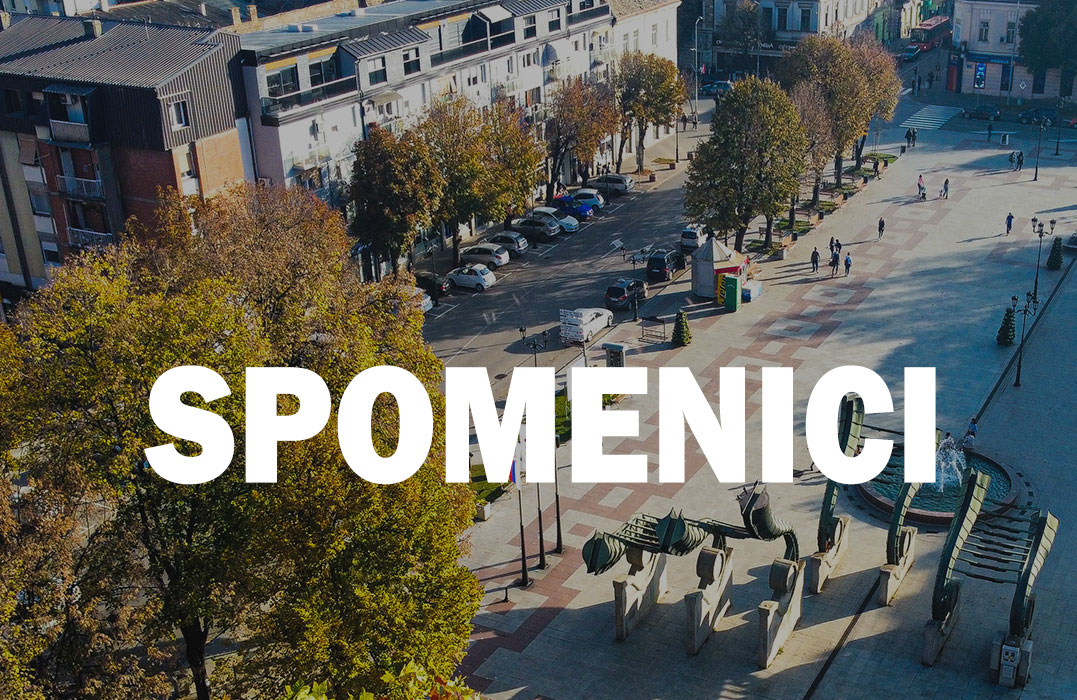
In the middle of the city center, in 1975, the Monument to the Revolution was placed, which was the work of architects Sveta Davič and Miša David, whose idea was never fully implemented.


This whole space is shaped like a forum where various activities, festivals, and gatherings take place. In the middle of the 20th century, there was a large green area in the place where today’s monument is located.


The area around the monument was, first of all, shaped like an amphitheater made of concrete elements and a red base, which represented the ancient period.


With the remodeling of the city center a few years ago, there was also a change in appearance, so that part of the amphitheater no longer exists and is now a city square of the demonstration type, modeled on most cities.


From the original appearance of the monument, seven forms in metal in the form of giant trumpets remain. They are associated with the 7 Vojvodina brigades and are positioned according to the place of origin, three facing Fruška Gora and four facing Bosnia. However, there are other interpretations, such as a call for an uprising and revolt, but also for the calm of the day.

The memorial area near the Revolution monument was originally made of concrete elements and red brick, and there are seven metal forms above it. The horn, that is, the trumpet, is a symbol of a call to an uprising or revolt, which justifies the name of the monument.

MONUMENT TO ŽARKO MILADINOVIĆ


The monument to Žarko Miladinović is located in front of the Main Post Office and was built in honor of the Ruma citizen who was once the Minister of Posts and Telegraphs in the government of Nikola Pašić.


He was the leader of the radicals, in whose house, in Glavna gradska street, on November 24, 1918, people decided to join Srem to Serbia.

MONUMENT “STATUES”


The Monument to the Statues is located next to the M-21 highway between Ruma and Irig. It was built by the citizens of Ruma as a sign of gratitude that the plague that reigned in Srem in 1795/96, and literally halved the population of Irig, did not spread to their town.


The statues are located at the place where military guards (sanitary cordon) were organized to prevent people from leaving the infected area.


As such, it represents one of the few monuments of health culture in this part of Europe. The monument is located on the left and right sides of the Ruma-Irig road.


It is 4 kilometers from Ruma and 7 kilometers from Irig. The main, that is, the larger group is located going from Ruma towards Irig on the left, and the second group, smaller, is on the right side of the road. The building on the left side of the road has the shape of a baroque Roman Catholic altar, while the building on the right side of the road is in the form of simple pillars with a circular base. At the top of the larger group is the crucified Jesus Christ, and below him are the figures of St. Rock and St. Sebastian.


The statues were last renovated in 1937 and were in very poor condition. In September 2011, the restoration of this unique monument began.


Funds for the reconstruction were provided by the Provincial Secretariat for Culture and the Rotary Club of Ruma. In order to preserve the original appearance, the Institute for the Protection of Cultural Monuments Srem provided the conditions for carrying out the works. Today, the monument can boast of its new look and can be an attractive tourist offer.

“CHILDREN WITH A BOOK” MONUMENT


The monument “Children with a Book” is located in the Small Park in Ruma and is the work of sculptor and medalist Slavka Petrović Sredović (1907-1978).
A monument representing a group of children engrossed in reading a book. It was purchased in 1955, after Slavka’s first post-war exhibition held in Ruma, on the premises of the City Library.


During her artistic career, Slavka Petrović Sredović participated in numerous exhibitions in the country and abroad.

The monument to Jovan Jovanović Zmaj is the first monument in this area and was built in 1911 for the first time.

MONUMENT TO JOVAN JOVANOVIĆ ZMAJ


Monument to “Jovan Jovanović Zmaj” in front of the school of the same name – Seven years after the death of the famous poet Jovan Jovanović Zmaj, the Serbian women’s charitable cooperative in Ruma launched an action to raise his monument.


This whole space is shaped like a forum where various activities, festivities and gatherings take place. In the middle of the 20th century, there was a large green area in the place where today’s monument is located.


The initiator of this action was Milena Miladinović, bearing in mind the fact that the famous poet was happy to stay in our city. In just eight months, from March to October 1911, the necessary funds were collected and the monument was built. The bust of the poet was made by Belgrade sculptor Đorđe Jovanović, a regular member of SANU.


The bronze bust is placed on a marble plinth, at the base of which is carved a lyre, a laurel branch, and a wreath with a bouquet of roses as a memory of Đulići (roses in Turkish). At the top of the plinth, directly below the bust, the poet’s name and year of birth and death are engraved: “ČIKA JOVA ZMAJ 1833 – 1904”, and below this inscription is engraved the text: “TO FAVORITE POET – GRATEFUL SERBIAN WOMEN”.


The monument was placed in front of the Serbian school, today “Zmaj Jova Jovanović” elementary school, and was ceremonially unveiled on October 23, 1911. It was the first monument built to the famous poet, not counting the one on his grave in Sremska Kamenica. During the First World War, the monument was demolished and hidden by Hungarian soldiers. After the war, it was installed again in the same place. In the Second World War, the Croatian army removed the monument again and it disappeared without a trace. Finally, in 1951, a new monument was created that still adorns the plateau in front of the Dragon School. It was modeled after the old monument. It was ceremoniously unveiled on June 3, 1951, as can be seen from the inscription on it: “RESTORED BY THE CITY PEOPLE’S COMMITTEE AND ORGANIZATION OF THE POPULAR FRONT – RUMA 3rd June 1951.” According to the memories of Professor Đorđe Arsenić, it was made by the sculptor Ilija Kolarević, who was a student of Đorđe Jovanović.

“AIRCRAFT WING” MONUMENT


The monument in the form of an airplane wing is located outside the settlement, in the extension of Vladimira Nazor Street, on the site
where in the first half of 1945 there was a war airfield, from which, towards the end of the Second World War,
the planes that took part in the breakthrough of the Srem front took off.
This whole space is shaped like a forum where various activities, festivities, and gatherings take place. In the middle of the 20th century, there was a large green area in the place where today’s monument is located.


The monument was built ten years after the end of the Second World War.
Also, the monument preserves the memory of the first pilot school in Serbia that worked from 1948 to 1954 at this airport. During the commemoration of five decades since the opening of the pilot school, a commemorative plaque to this school was placed on the monument.